
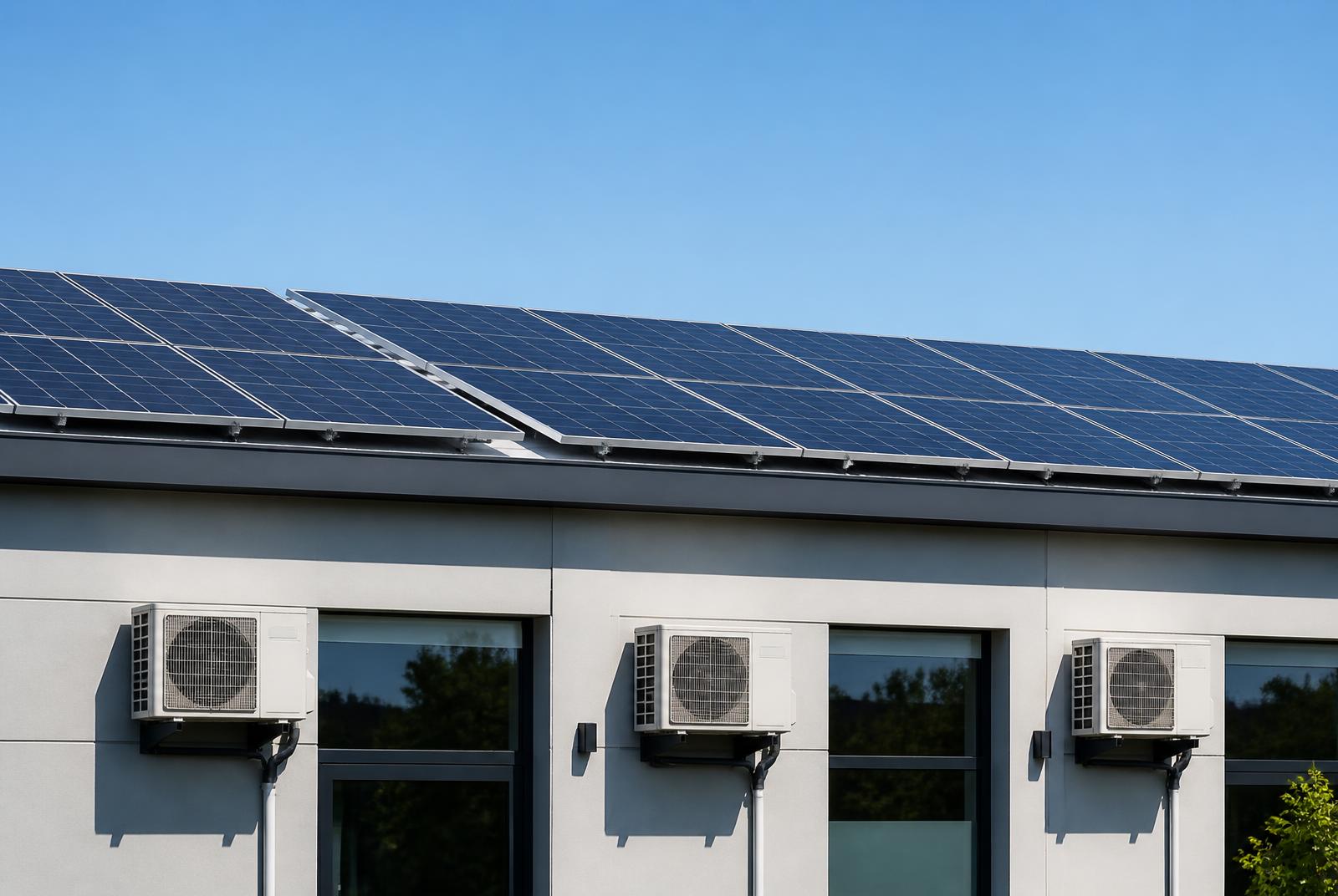
Industry research reviewed by ANDES projects that the Hybrid Solar Air Conditioners segment could reach approximately US$11.4 billion by 2030 as cooling demand and solar PV deployment continue to expand.
What is happening
Analyst coverage of the Hybrid Solar Air Conditioners segment describes a category moving from niche interest toward broader commercial availability. MarketGlass / Global Industry Analysts projects the segment at roughly US$11.4 billion by 2030. That figure is a forecast, and it depends on how the analyst defines the segment; other researchers using different boundaries publish different numbers.
At the same time, the underlying energy picture continues to shift. The International Energy Agency reports in its Global Energy Review 2026 that solar PV generation grew by around 600 TWh in 2025, reaching close to 2,700 TWh and more than 8% of global electricity generation. The IEA also reports that solar PV accounted for more than three-quarters of new renewable capacity additions worldwide in 2025.
Why it matters
Air conditioning load is largely a daytime load, and photovoltaic generation is a daytime resource. That overlap is the commercial logic behind solar-assisted and hybrid cooling equipment: cooling demand, solar generation and daytime energy requirements point in the same direction.
Broader cooling context reinforces the trend. UNEP's Global Cooling Watch 2025 indicates that cooling demand could more than triple by 2050 under business-as-usual conditions. Markets with high solar resource and high cooling demand are the ones where the question is asked first.
Key data
Hybrid Solar Air Conditioners segment projected at approximately US$11.4 billion by 2030 — forecast, definition-dependent (MarketGlass / Global Industry Analysts).
Solar PV generation up roughly 600 TWh in 2025, reaching nearly 2,700 TWh and over 8% of global electricity generation (IEA, Global Energy Review 2026).
Solar PV represented more than three-quarters of new renewable capacity additions worldwide in 2025 (IEA, Global Energy Review 2026).
Cooling demand could more than triple by 2050 under business-as-usual conditions (UNEP, Global Cooling Watch 2025).
Methodology note
The US$11.4 billion figure is a published market projection, not a measured market size and not a guarantee of future demand. Market forecasts vary with the analyst's segment definition, geographic scope and modelling assumptions. ANDES did not originate this research; it is referenced here with attribution and paraphrased.