
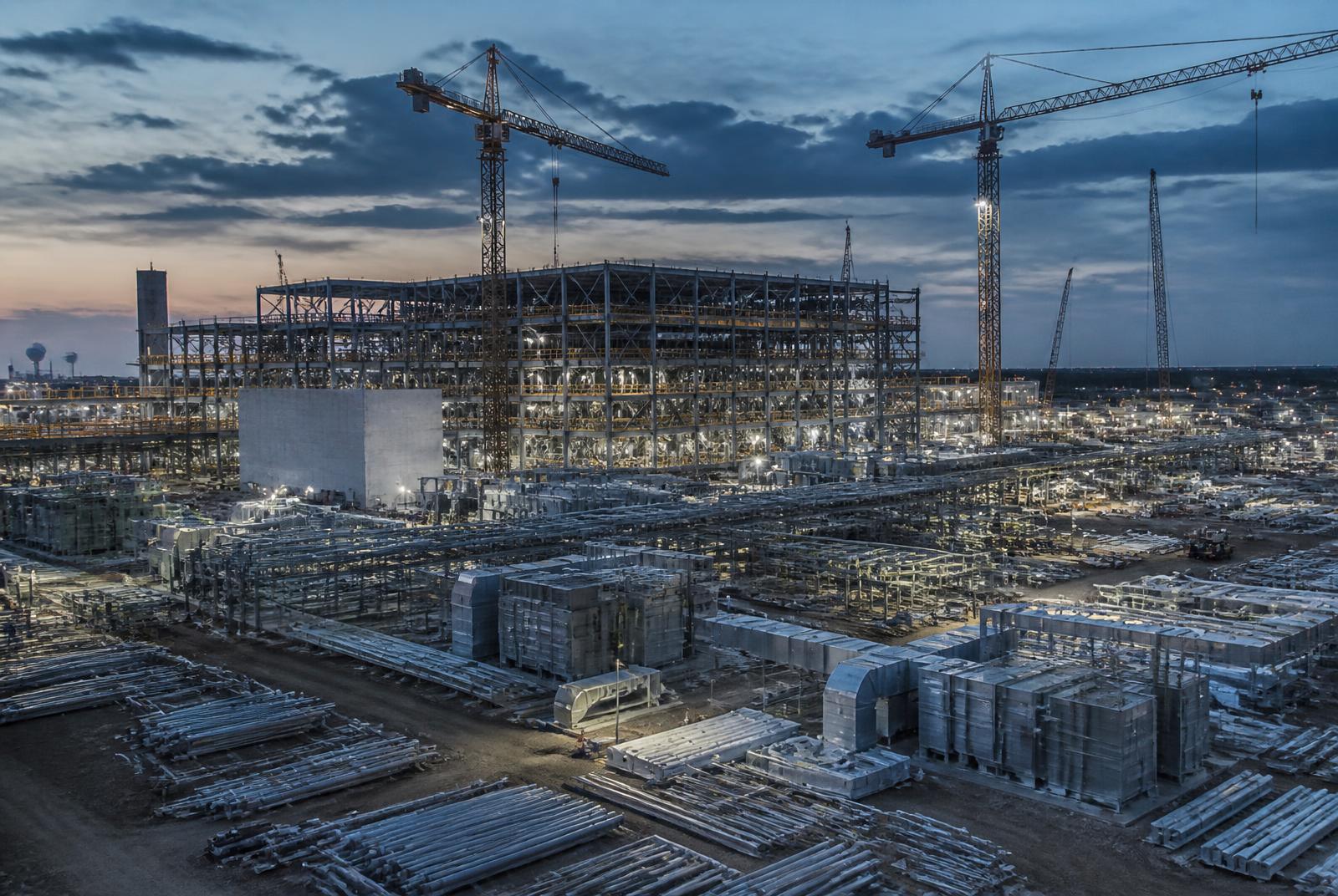
On 6 August 2026 the Office of the Texas Governor announced that SpaceX will construct a vertically integrated semiconductor fabrication plant in Grimes County, Texas, with a stated first phase of more than US$16.8 billion in capital investment and 3,000 new jobs. ANDES reports this as public-source intelligence and reviews only what mega-scale industrial construction typically means for procurement disciplines.
Executive signal
Concentrated, mega-scale industrial construction compresses procurement timelines for everything that supports a building envelope and its process environment: mechanical equipment, refrigeration, electrical distribution, controls, instrumentation and consumable MRO. When a single corridor absorbs that volume, buyers with clean technical documentation move faster than buyers who negotiate on description alone.
What changed
The Office of the Texas Governor announced on 6 August 2026 that SpaceX will construct a vertically integrated semiconductor fabrication plant in Grimes County, Texas. The announcement states a first phase of more than US$16.8 billion in capital investment and the creation of 3,000 new jobs. Those are the published figures; ANDES adds no estimate of scope, schedule, package structure or supplier selection beyond them.
Why procurement should care
Regional demand concentration affects how quickly technical requirements can be quoted, regardless of who wins any given package.
Facilities and MEP scopes for advanced manufacturing are specification-driven; approximate part descriptions create rework at the review stage.
Component traceability — manufacturer, exact part number, revision, model or series — becomes the practical control on substitution risk.
Maintenance and operations demand follows construction; MRO planning that starts at commissioning starts late.
Implications for project supply
For multi-line project requirements, the decisive variable is intake quality. A bill of materials or equipment schedule that carries manufacturer, part number, model or specification, quantity and destination can be reviewed line by line. A list of generic descriptions cannot, and the difference shows up as clarification cycles rather than as price.
The same logic applies to lifecycle-affected components. Where a referenced part is discontinued or superseded, the requirement should be reviewed against the application rather than resolved by assumed equivalence.
Supplier-readiness questions
Is every line identified by manufacturer and exact part number, or only by description?
Are model, series, revision and application conditions documented where they affect selection?
Which lines are lifecycle-sensitive and need replacement verification before quotation?
Are destination, packaging and documentation requirements defined at intake rather than after award?
Is there a single commercial interface for multi-family requirements, or one thread per family?
Source and disclaimer
All project figures in this briefing come from the official announcement published by the Office of the Texas Governor on 6 August 2026 and are paraphrased with attribution. ANDES INTERNATIONAL LLC has no relationship with, endorsement from, or role in the named project or the companies referenced. Nothing here states inventory, availability, authorization, pricing, lead time or certification.